
Marketing budgets for startups: planning, realistic marketing costs, strategies and ways to save
 Leonhard Pleschberger
For a startup, marketing is not an optional line in the cost plan. It is a core driver of growth. Very early on it decides whether a business model reaches visibility, demand and paying customers. At the same time budgets are tight, and a wrong call shows up immediately in your runway and in how far you can scale.
In this article we lay out realistic marketing and staffing costs for different startup categories in the first financial year. If you are already past that stage, the numbers still give you a solid reference point. They are based on setups that have been tested in practice during early growth phases and assume a lean use of resources. The aim is clear orientation for founders, investors and management teams, so marketing budgets become plannable, comparable and steerable.
The focus throughout is on measurable activity, clear ownership and cost structures that make growth possible without tying up capital unnecessarily.
Why are we the experts on this? With our leading marketing subscription we work with startups across the German speaking market on both strategy and execution. You get a dedicated marketing manager who, together with a team of specialists, actually delivers against your goals.
Let us start with the rough shape of the numbers. This covers media budget and staffing costs together:
- Below €50,000 total budget: barely scalable
- €70,000 to €120,000: solid MVP marketing
- €150,000 and up: growth with measurable traction
Which marketing budget suits which startup?
Why marketing matters so much for startups
In a startup, marketing decides early on between momentum and standstill. A strong product is not enough if the market never hears about it or does not understand the benefit. Marketing creates visibility, positions the offer clearly and translates product features into something the audience actually cares about.
In the first year in particular, marketing produces valid signals from the market. Founders find out whether demand exists, which channels work and how efficiently customers can be acquired. Those findings feed straight back into product development, pricing and the go to market strategy.
Marketing is also a central lever for scalability. Repeatable customer acquisition processes make planning more reliable, reduce risk and strengthen your position in conversations with investors. Startups that set marketing up properly make decisions from data and give themselves a clear competitive advantage.
Rules of thumb for a startup budget
Before the detail, four numbers worth committing to memory:
- 5 % to 20 % of revenue typically goes into marketing.
- 15 % to 30 % in the early phase, when there is no stable revenue to take a percentage of yet.
- €30,000 to €150,000 is where most startups land in their first year.
- €150,000 and above is the point at which measurable traction becomes realistic.
These are orientation figures, not targets. A startup that reaches product market fit on €40,000 has done better than one that spent €200,000 without learning anything. But if your plan sits well below the first band, it is worth asking honestly whether the plan is lean or simply underfunded.
Typical marketing costs for startups by industry
Average marketing costs for startups vary enormously by industry. A software startup will prioritise entirely different channels and activities than a local cafe. In year one the goal is not maximum reach, it is demand, valid data and repeatable customer acquisition. The benchmarks below show typical annual budgets for startups in their early phase.
It is important that you adapt the marketing budget to your own needs and goals. Look at how much established companies in your industry put into digital marketing and plan a similar percentage of revenue for your own activity. Tools like Google Ads and social media marketing are particularly efficient for startups on a small budget. They also help you plan and validate your MVP.
Remember that it is not only about how much you spend, but about how effectively you spend it. The table below is our learning from working with early stage teams:
| Industry | Marketing costs | Staffing costs | Total cost, year 1 |
|---|---|---|---|
| SaaS (B2B) | €30,000 to €80,000 | €40,000 to €70,000 | €70,000 to €150,000 |
| SaaS (B2C) | €40,000 to €120,000 | €45,000 to €80,000 | €85,000 to €200,000 |
| E-commerce (D2C) | €50,000 to €150,000 | €50,000 to €90,000 | €100,000 to €240,000 |
| Marketplace / platform | €60,000 to €200,000 | €60,000 to €100,000 | €120,000 to €300,000 |
| FinTech | €40,000 to €100,000 | €50,000 to €80,000 | €90,000 to €180,000 |
| HealthTech | €30,000 to €90,000 | €45,000 to €75,000 | €75,000 to €165,000 |
| Local services | €10,000 to €30,000 | €20,000 to €40,000 | €30,000 to €70,000 |
| EdTech | €20,000 to €60,000 | €35,000 to €60,000 | €55,000 to €120,000 |
| AI / deep tech | €25,000 to €70,000 | €40,000 to €65,000 | €65,000 to €135,000 |
On average, startups put almost as much into people as into media. With the monthly cancellable marketing subscription from Einfachmarketing you save a significant share of those staffing costs, because you get the combined expertise of our whole team. Your marketing manager looks after you the way an in house hire would. See our prices.
The media budget, broken down
| Industry | Typical marketing channels | Annual marketing budget | Cost split (simplified) |
|---|---|---|---|
| SaaS (B2B) | Google Ads, LinkedIn Ads, content, SEO | €30,000 to €80,000 | Ads 40 %, content and SEO 30 %, tools 15 %, design 15 % |
| SaaS (B2C) | Meta Ads, influencers, app ads | €40,000 to €120,000 | Ads 60 %, influencers 20 %, creatives 20 % |
| E-commerce (D2C) | Meta Ads, Google Shopping, UGC | €50,000 to €150,000 | Ads 70 %, creatives 20 %, tools 10 % |
| Marketplace / platform | Performance ads, referral, PR | €60,000 to €200,000 | Ads 55 %, incentives 25 %, PR 10 %, tools 10 % |
| FinTech | Performance ads, content, compliance | €40,000 to €100,000 | Ads 35 %, content 30 %, legal and review 20 %, tools 15 % |
| HealthTech | Content, SEO, specialist portals | €30,000 to €90,000 | Content 40 %, ads 25 %, SEO 20 %, tools 15 % |
| Local services (trades, coaching and similar) | Google Ads, local SEO | €10,000 to €30,000 | Ads 60 %, SEO 25 %, website 15 % |
| EdTech | Content, social ads, partnerships | €20,000 to €60,000 | Content 35 %, ads 40 %, partners 15 %, tools 10 % |
| AI / deep tech | Thought leadership, PR, events | €25,000 to €70,000 | Content and PR 45 %, events 25 %, ads 20 %, tools 10 % |
Read that table alongside the previous one and the ranking becomes clear. Excluding staffing costs, annual marketing budgets in year one run from €60,000 to €200,000 for a marketplace or platform, €50,000 to €150,000 in D2C e-commerce, €40,000 to €120,000 for B2C SaaS and the same €40,000 to €100,000 range for FinTech. HealthTech sits at €30,000 to €90,000, B2B SaaS at €30,000 to €80,000, AI and deep tech at €25,000 to €70,000, EdTech at €20,000 to €60,000, and local services at €10,000 to €30,000.
The split inside those budgets tells you as much as the total. Take B2B SaaS as the example: roughly 40 % goes into ads, 30 % into content and SEO, 15 % into tools and 15 % into design, across Google Ads, LinkedIn Ads, content and SEO. Compare that with D2C e-commerce, where 70 % goes straight into media, and you can see two entirely different machines. One buys attention and converts it on the spot. The other builds a case over months and lets sales close it. Copying the wrong split is one of the more expensive mistakes a founder can make.
The leading marketing subscription from Einfachmarketing
Startups do not need an oversized marketing department. They need clear priorities, speed and measurable results. That is exactly what the Einfachmarketing marketing subscription was built for. It bundles strategic thinking, hands on execution and continuous optimisation into one plannable model.
The subscription is designed for startups in their early and middle phase who want to build growth without heavy fixed costs or long contracts. Instead of coordinating several suppliers, founders get one point of contact with clear responsibility for performance and delivery, and a proven track record behind it.
The focus sits on channels that demonstrably create demand: performance marketing, conversion optimised landing pages, clean tracking and clear messaging. Nothing is executed on gut feel. Activity is prioritised against data and adjusted as the data moves.
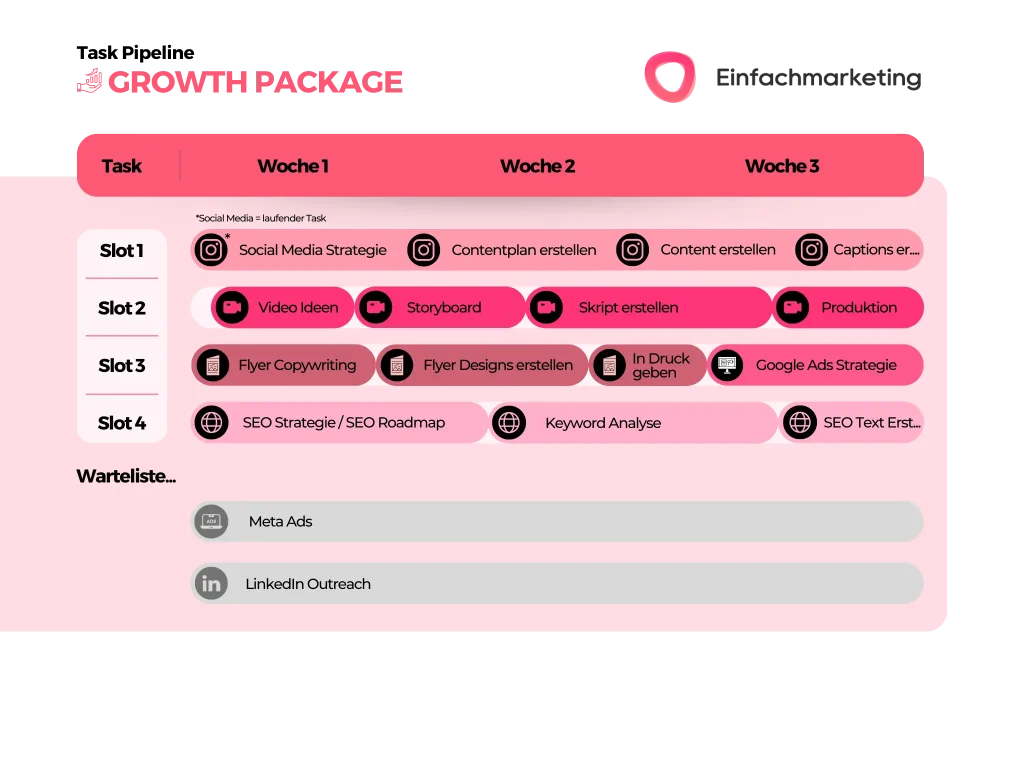
The result is a scalable marketing setup that is ready quickly, stays transparent in its costs and follows the actual progress of the business. Einfachmarketing becomes the external marketing team that thinks, delivers and takes responsibility. Picture a team of marketing specialists working for you the way an employee would, without the cost of an internal department. We analyse your audience, your goals and your industry to build a marketing strategy aimed at revenue and growth, so you can concentrate on the core of your business while we look after the marketing.
Two things are worth saying about the table above before you use it. First, the staffing column is the one founders underestimate most often. A marketing hire is not only a salary, it is recruiting time, onboarding time and the risk that the first hire turns out to be the wrong specialism for the stage you are in. Second, the ranges are wide on purpose. Where you land inside them is decided by how clear your positioning is and how disciplined you are about stopping things that do not work, not by how ambitious your plan looks in a deck.
Planning the budget for marketing activity
How to plan an effective marketing budget
An effective marketing budget does not come from estimates. It comes from clear goals and priorities. Startups need to know who they want to reach, what is being sold and how success will be measured. Only then does budget get allocated.
It starts with the business model. B2B startups invest more heavily in content, performance and lead nurturing. B2C models move to paid ads and creative production sooner. Budget always follows the logic of how you sell, never the other way around.
The next step is splitting the budget into fixed and variable costs. Fixed costs are tools, specialists and the basic setup. Variable costs are media budgets, tests and scaling. That separation creates control and stops too much money going into reach too early.
Monthly planning matters. Annual budgets feel safe but they do not steer anything. A monthly frame with clear KPIs makes fast decisions possible. Channels that do not deliver get cut back or stopped.
An effective marketing budget stays flexible. What works gets more money, what does not gets replaced. Startups that adjust budget continuously and steer from data shorten their learning cycles and secure growth that lasts.
| Business model | Target customer | Buying decision | Sales logic | Marketing focus |
|---|---|---|---|---|
| B2B SaaS | Companies | Rational, several stakeholders | Sales driven | Content, lead generation, LinkedIn, Google |
| B2C SaaS | Consumers | Emotional plus benefit | Self service | Paid social, creatives, conversion |
| E-commerce (D2C) | Consumers | Fast, impulsive | Direct sale | Performance ads, UGC, retargeting |
| Marketplace | Two sides | Trust plus benefit | Network effects | Performance plus incentives |
| Service / local | Local customers | Need driven | Direct contact | Google Ads, local SEO |
| High ticket / consulting | Decision makers | Trust, expertise | Personal | Content, PR, thought leadership |
The business model determines the budget logic
| Business model | Target customer | Buying decision | Sales logic | Marketing focus |
|---|---|---|---|---|
| B2B SaaS | Companies | Rational, several stakeholders | Sales driven | Content, lead generation, LinkedIn, Google |
| B2C SaaS | Consumers | Emotional plus benefit | Self service | Paid social, creatives, conversion |
| E-commerce (D2C) | Consumers | Fast, impulsive | Direct sale | Performance ads, UGC, retargeting |
| Marketplace | Two sides | Trust plus benefit | Network effects | Performance plus incentives |
| Service / local | Local customers | Need driven | Direct contact | Google Ads, local SEO |
| High ticket / consulting | Decision makers | Trust, expertise | Personal | Content, PR, thought leadership |
The questions we ask at Einfachmarketing to size your budget
- Who decides on the purchase? One consumer, or several stakeholders?
- How long does the decision take? Minutes, days or months?
- How often does a customer buy? Once, or repeatedly?
- How is it sold? Self service, or through a sales conversation?
Benchmarks for startup marketing budgets
There is no universal answer here, because the average marketing budget depends heavily on the industry and on how far along the company is. Many companies put a set percentage of revenue into marketing, often between 5 % and 20 %. A new company aiming to grow fast will plan a higher share, while an established business with a stable customer base may spend considerably less. What matters is analysing and optimising your marketing continuously so you maximise the return on what you invest. Treat marketing as an investment in the future of your startup, not as a short term cost.
Investing across different marketing channels
Spreading investment across several marketing channels is essential if you want to reach your audience properly. Social media marketing, content marketing and SEO are only some of the options open to you. Work out which channels are most effective for your audience and prioritise accordingly. Google Ads can be a good choice when you need reach quickly, while content marketing and SEO build sustainable growth over the longer term. Email marketing remains an effective channel for retention and for lifting revenue. And remember that it is not only about which channels you invest in, but about how you build and optimise the campaigns inside them. Many companies should try several channels and measure the results, then keep improving the strategy from there.
Would you rather have it worked out for you? Put your marketing team together and see the price immediately. Basic from €1,490, Consulting from €490, cancellable monthly. Build your team.
Is there a perfect channel? Strategies for more efficient marketing
Finding the right marketing activity
To work out which marketing activity suits your startup, start by analysing your audience closely.
Which channels do they use? What kind of content speaks to them? Begin with small, measurable campaigns across several channels, social media marketing, email marketing or content marketing among them, and analyse the results. Which activity brings in the most revenue and the strongest retention?
Efficiency in marketing does not come from spending less. It comes from clear priorities and clean processes. Startups get more out of their budget when every activity is measurable and feeds directly into revenue or qualified demand.
One of the biggest levers is focusing on a small number of channels. Too many parallel activities dilute both budget and attention. Two well managed channels deliver more than five half tended ones. Decisions come from data, not from assumptions.
Positioning is the next factor. The clearer your benefit and your audience are defined, the cheaper your clicks and conversions become. Vague messaging raises waste and stretches out the learning phase.
Testing in short cycles lifts efficiency noticeably. Creatives, audiences and offers are tested continuously and cut quickly. What works gets scaled. What does not gets stopped.
Clean tracking matters just as much. Without reliable data you cannot steer a budget. Clear KPIs such as CAC, conversion rate and cost per lead create transparency and let you optimise fast.
Finally, lean structures raise efficiency. External specialists, clear ownership and standardised processes reduce fixed costs and keep marketing agile. Efficient marketing stays adaptable and growth oriented.
ROI: analysing what your investment brings back
ROI (return on investment) is the key figure for judging how efficient your marketing spend is. Analyse how much revenue each individual activity generates and set that against what it costs.
Which campaigns deliver the highest ROI, and which are less effective? It matters that you do not only look at short term revenue but also at the longer term effects, such as growing brand awareness and stronger customer retention.
A thorough ROI analysis helps you deploy your budget where it works and keep improving your strategy. Many companies neglect this analysis, which leads to inefficient activity and unnecessary cost. Concentrate on the channels that promise the highest ROI and put your budget there. A new company benefits from this discipline more than anyone.
The role of efficiency in budget planning
Efficiency is central to budget planning in a startup. Because marketing budgets are usually limited, every euro has to be used well. Plan your budget so you get the best results at the lowest cost. Prioritise activity that has measurable goals and promises a strong ROI. Keep optimising your campaigns to raise efficiency and extend your reach. Many companies should concentrate on strategies that offer good value, content marketing and SEO among them. Paid advertising such as Google Ads can generate reach quickly, but it is often more expensive than other channels. Analyse which channels work best for your audience and adjust your budget accordingly. Efficiency is the key to staying competitive on a small budget and generating more revenue. Companies invest wisely when they reinvest a share of their revenue.
Marketing costs: the challenges of budgeting for startups
Common mistakes in budget planning
Many startups fall into the same traps. A frequent one is setting the marketing budget too low or never defining it clearly. Marketing often gets treated as a cost factor rather than as an investment in the company's future. Another mistake is failing to analyse the activity and never measuring ROI. Without that analysis it is hard to judge the efficiency of individual channels and to allocate budget well. A new company should also be careful not to concentrate the entire budget on one single channel. Spreading across several channels extends reach and reduces risk. Companies should try different channels. Many should also plan a contingency so they can react to events they did not see coming.
How companies plan their marketing budgets
The way companies plan a marketing budget varies enormously. Some fix a percentage of revenue for marketing, others build a budget from their goals and the expected costs. Some analyse their competitors' budgets and adjust their own strategy accordingly. Many use tools and software to plan, manage and analyse their activity. The key to successful budget planning is flexibility. The budget should be reviewed and adjusted regularly so it responds to changes in the market and in customer behaviour. Companies invest well when they keep the budget dynamic. A well planned marketing budget is essential.
Tips for getting past budgeting problems
To get past budgeting problems, set realistic goals and prioritise the budget against them. Analyse which channels are most effective for your audience and concentrate your budget there. It is sensible to start with small, measurable campaigns and analyse the results carefully so you can raise efficiency. Use tools to track your activity and measure ROI. Be ready to adjust your strategy when something does not deliver what you hoped. Companies should also consider bringing in external specialists to benefit from their expertise and avoid predictable mistakes. A small budget is no obstacle when it is used intelligently, provided the decisions behind it are made deliberately rather than by default. Companies invest in their own future when they solve their budgeting problems.